The Bully Bond Market
“I used to think that if there was reincarnation, I wanted to come back as the president or the pope or as a .400 baseball hitter. But now I would like to come back as the bond market. You can intimidate everybody.”
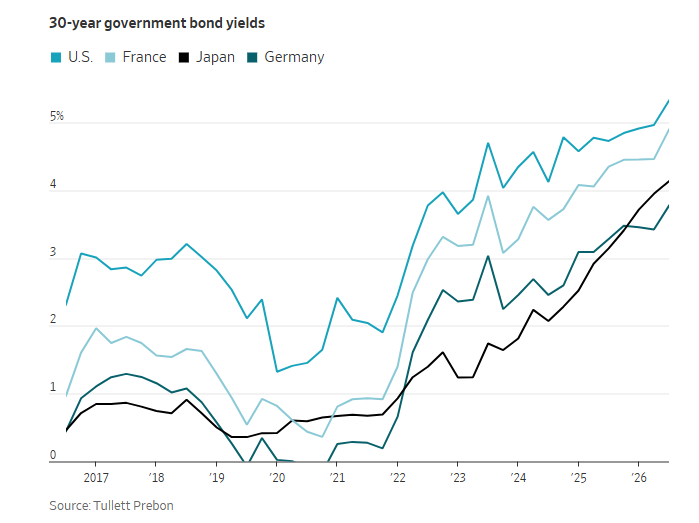
The yield on the 30 year Treasury bond hit 5.34 on August 19th, the highest level since 2007. The 10 year Treasury is not too far behind at 4.7%; driving the 30 year mortgage rate up to 6.75% up 70 basis points since the start of the Iran conflict.
Interest rates are rising globally and the dynamics driving rates higher, Treasury driven supply, AI-driven corporate issuance, and new “hidden” debt, are not changing anytime soon.
Read | Watch | Listen: Apple | Spotify
Sec. Bessent’s intervention, is it relevant?
In response to rising rates, Treasury Secretary Scott Bessent announced the government would “at least double” its buyback operations for 10-20 year debt, from $2bil to $4bil per operation. Essentially swapping short term debt for long term debt, providing liquidity to the long end of the bond market.
It worked for about 24 hrs, sending rates down, only to retrace most of the fall days later.
While much is being made over this “technical” managing of the yield curve, it’s not new, and against $40 trillion dollars in outstanding debt its minimal.
But the signaling matters. Why is the Treasury getting involved to begin with? Is something broken?
The concern remains a disorderly rise in rates; rising borrowing costs worsen deficits, require more issuance, and continue to push rates higher. This is the fear, and the doomers are out.
Per the WSJ, “A mere 0.1 percentage-point rate move above forecasts in all rates would add $379 billion in net interest expenses, according to the CBO.”(1) To me this reads as an annual projection, but it’s really a 10 year CBO cumulative projection. They could be clearer, in my opinion.
While the risk of a debt loop is real, it’s not real now. Rates have been in a tight, rather normal range all year. We are just in the upper of that range today.
Planning point: Politicians don’t act until the market forces them to act; reforms on entitlement spending will happen when the bond market forces the deficit issues to be resolved. Millennials and younger may need to stress test their Social Security assumptions in their retirement planning.
AI is causing interest rates to rise.
While much of the debate around the AI data center build out has centered around environmental impact and rising consumer energy prices, less attention has been given to the crowding-out effect in global debt markets.
***For further perspective on the vitriol for data centers, see Derek Thompson linked —>
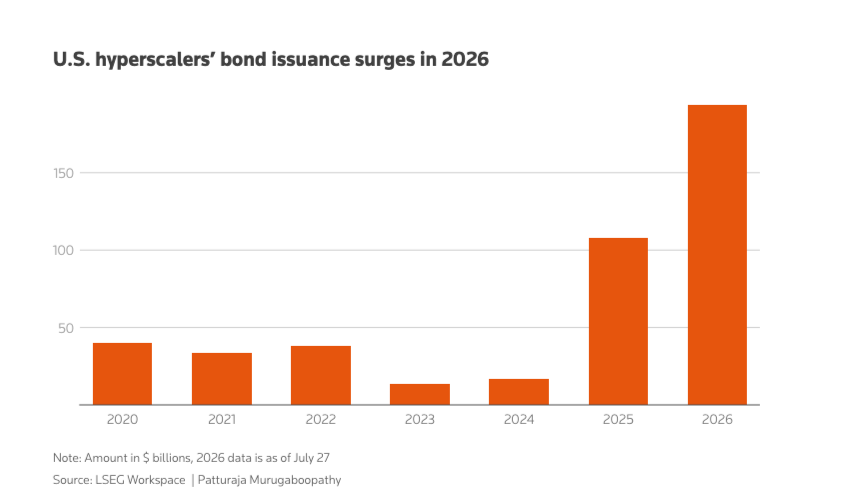
As I noted last month, and throughout my writing, hyperscalers (Alphabet, Amazon, Meta, Microsoft, and Oracle) are issuing large, unprecedented amounts of debt to fund their AI ambitions. Most of this debt is long term. (2)
This additional supply of debt has to attract marginal buyers, and there is not unlimited capital to purchase long-maturity debt. The buyers of long-term Treasury debt, think pension funds, insurance companies, asset managers, foreign central bank reserves, now have higher-yielding corporate alternatives. So underlying rates have to rise to attract the next marginal buyer.
The Mechanism: More AI corporate bond supply→ more duration for investors to absorb→ higher required yields
What’s an SPV and should I lose sleep over it?
The Ai build out is being financed through multiple channels: hyperscale cash flows, direct corporate bond issuance, and a growing network of Special Purpose Vehicles (SPVs) that keep debt off the corporate balance sheet, spreading it across private credit and securitization markets. (3)
How an SPV works
An SPV is a separate legal sand box that allows companies to isolate the data center or GPUs or whatever project, against project specific cash flows, rather than adding the project assets and liabilities on the corporate balance sheet.
Securitization is simply the act of pooling the project linked cash flows to investable securities, turning what is in the sand box into slices of bonds that investors can buy.
Securitization has negative connotations as it sounds very GFCish. But securitization provides capital for just about everything: mortgages, auto loans, student loans, jet engines, you name it. This process generally makes end consumer financing and products cheaper.
Why Securitize GPUs Now
AI infrastructure is just so capital intensive that SPVs give tech companies a way to tap asset backed investors and private credit without utilizing their own balance sheet.
But why now? What’s the rush? While supporters of the ecosystem claim compute is just so scarce, and there is just soooo much unmet demand.
I'm not sure how much of that story I can buy.
So much of investing and stock prices hinges on the narratives and second derivative thinking. If growth decelerates, this hurts the scarce compute narrative. Are the growth of SPVs and securitization forcing the pace of infrastructure buildout before true end consumer demand is actually there?
The market is clearly asking this same question, evident by Nvidia’s stock price, just range bound, struggling to find direction.
The notable proposed SPVs list is growing…
Nvidia AI financing platform — A proposed $500 billion capital initiative to finance AI infrastructure with loans backed by Nvidia equipment; announced August 10, 2026.
Nvidia–OpenAI Ohio project — Financing and credit support for an OpenAI-linked, 10-gigawatt Ohio data-center project; reported July 26, 2026.
Broadcom AI XPV Platform — A $35 billion SPV-backed platform that buys Google AI chips and leases compute capacity to Anthropic; announced June 9, 2026.
Broadcom follow-on chip-financing SPV — A proposed $70 billion to $80 billion financing vehicle for additional AI-chip purchases; reported August 20–21, 2026.
Meta Louisiana data-center SPV — Nearly $30 billion in project financing for Meta’s Louisiana data-center campus; reported October 16, 2025.
xAI Colossus 2 chip SPV — Roughly $20 billion of equity and debt raised through an SPV to acquire Nvidia chips for xAI’s Memphis expansion; reported October 7, 2025.
Lambda GPU financing vehicle — A $500 million loan secured by Nvidia GPUs to fund cloud-computing expansion; announced April 4, 2024.
Nvidia-linked Nevada data-center financing — About $8.4 billion of high-yield bonds issued for a data center supported by Nvidia lease commitments; issued in February and April 2026.
Should you lose sleep over it? Maybe, know what you own.
What does this Bond Market mean for individual investors, especially retirees?
We’ve covered the macro story: rising Treasury supply, AI debt issuance, and the growing use of SPVs to move massive infrastructure financing into separate vehicles. But the real question is what this means for individual investors, especially retirees trying to generate income without taking risks they don’t fully see.
That brings us to a couple of conversations gaining traction on Reddit: first, whether today’s 5%-plus long-term Treasury yields can make the traditional 4% withdrawal rule more workable; and second, what investors actually own when they hold a broad bond fund like BND.
Can I just buy a 30y Treasury Bond yielding above 5%, because that’s greater than the 4% withdrawal rate rule of thumb?
This is a reasonable perspective, but it needs to be distinguished from retirement income planning. A nominal bond yield is not the same as an inflation-adjusted spending rate. The 4% withdrawal framework that is conventionally used as a rule of thumb starts as an initial withdrawal rate that then increases with some inflation adjustment. The 5% yield is set in stone. Inflation remains the retiree’s biggest retirement planning challenge.
What is often left out of the conversation is taxes. Assuming Treasury bonds are held in a taxable brokerage account, the interest payments are taxed at ordinary income tax rates. If the bonds are held in a pre-tax account like an IRA, the interest payments are tax-deferred; then taxes are paid on dollar distributions from the account again at ordinary income tax rates.
Point being: this doesn’t work; more robust investment and tax planning is required.
What are the risks in Core Bond funds like BND and AGG?
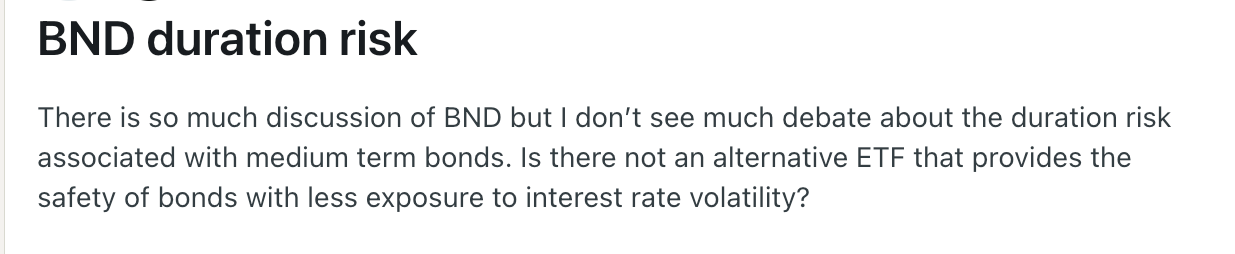
r/Bogleheads “BND duration risk,” Reddit (5)
Core bond funds, the meat and potatoes of most investor fixed income allocations, are largely tied to the US Aggregate Bond Index; that includes both BND (Vanguard Total Bond Market ETF) and AGG (iShares Core US Aggregate Bond ETF). This index is debt outstanding weighted, your dollars within the fund are allocated to the most indebted entities, reflecting the maturities of what is issued.
What is left out of the discussion is goals, time horizon, and the general purpose of holding bonds to begin with.
The maturity profile (duration) of the aggregate bond market may not be in alignment with an investor’s goals or objectives.
Now stack on AI exposure. While the index remains 70% US Government-related debt, AI related borrowing remains a growing share of issues in the index. Vanguard put is perfectly, “Investors hold high-quality bonds in large part to diversify equity risk. Yet at the margins, the new bonds being added to the index are increasingly a claim on the same AI investment cycle that has been driving equity returns….A broad “core” bond fund is gradually becoming a larger claim on the AI buildout, and an investor with substantial AI exposure in equities may be adding to that exposure, unknowingly, in fixed income.” (6)
I highlighted my preference to match fixed income maturity schedules to planned expenses earlier this year. Read it here.
What This Means for Your Portfolio Right Now
Rates are at the top of the range, not through it. The 30-year at 5.34% is the highest since 2007, but rates have traded in a tight band all year. The debt loop everyone is worried about is a real risk. It is not today's risk.
Your bond fund is quietly buying the AI trade. The hyperscalers are financing the buildout with long dated debt, and a growing share of it lands in the same aggregate index that sits inside BND and AGG. If you own AI in your equities (and you do), you may be adding to it in the one place you hold to diversify away from it.
A 5% yield is not a 5% spending rate. Nominal yields are fixed. Your expenses aren't, and neither is your tax bill. The math that makes a long Treasury look like a solution to the 4% rule doesn't survive inflation and ordinary income tax treatment.
Planning point: the fix isn't to abandon bonds. It's to know what you own, duration, credit, and what those bonds are actually a claim on, and to match maturities to the expenses they're meant to fund.