A Guide To Owning Bonds
I came across an article in the Wall Street Journal called “A Guide to Owning Bonds When They Are Selling Off.” Well, not much of a guide, but a short article covering retirees, younger investors, and paper losses. I felt it was largely insufficient.
So I’m going to give you a guide.
What does it mean when “Bonds Are Selling Off”?
For today’s conversation, we are focusing on high-quality investment-grade bonds like those issued by the U.S. Government or a large corporation. And we are talking about individual bonds, not funds or ETFs; more to come on this later.
First, bonds are not stocks; the underlying financial principles are different. A bond has a fixed payout and an end date; stocks have neither.
Bonds are contractual debt instruments. When interest rates are changing (they always are), the value of existing bonds has to change to match the prevailing interest rate offered by the market. So when I purchased a 10-year government bond at 4% a year ago, the new 10-year bond issued today now pays a 5% interest rate. The price of my existing bond has to go down to reflect the prevailing market rate; if I purchased at par, $1000, that same bond with 9 years remaining is about $930.
But regardless of interest rate changes, I will receive the par value of my bond at maturity.
So when the media writes, “bonds are selling off,” it is referring to the temporary price declines of existing bonds to reflect the current higher interest rate today.
Who needs to own bonds?
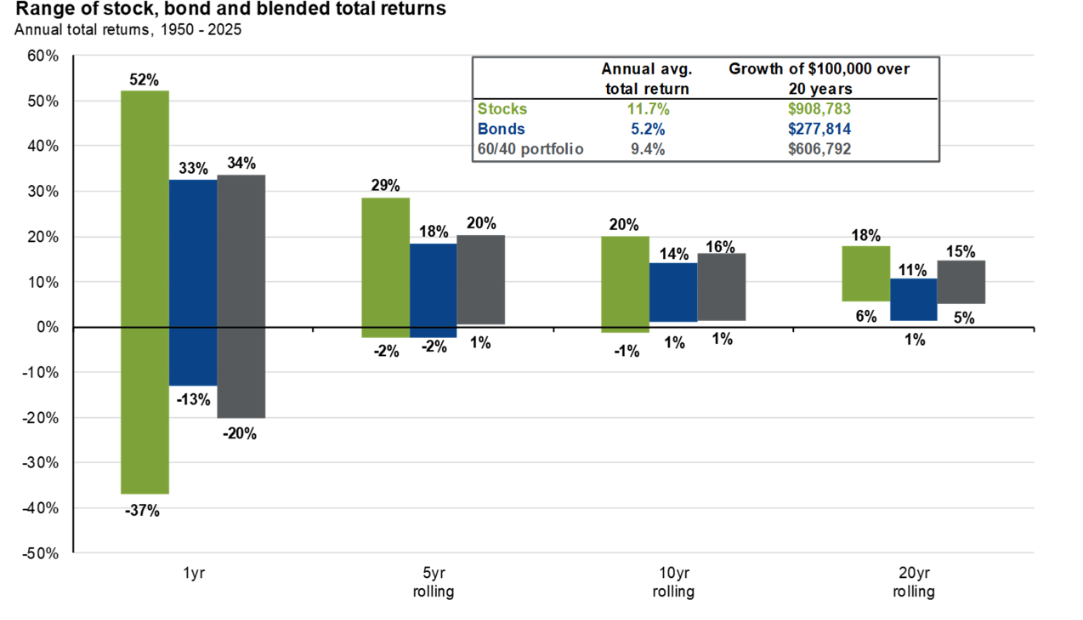
Source: Bloomberg, FactSet, Federal Reserve, Standard & Poor’s, Strategas/Ibbotson, J.P. Morgan Asset Management.
Guide to the Markets – U.S. Data are as of August 31, 2026.
Let’s make this very simple: we are removing the tactical investment decisions from this conversation and focusing on the primary consideration. When do you need your money?
Time, diversification, and volatility of returns: JPMorgan explains very simply that the longer your time frame, the lower your probability of loss in equities.
So who needs to own bonds? Anyone with short-term goals or objectives. What do I consider short? Sub 5 years is reasonable.
Longer than that especially 10 years +, the risk, especially after inflation, is that you lose the real purchasing power of your money.
As I highlighted earlier this year: “for the preservation of purchasing power…the safest long-term investment has clearly been a diversified portfolio of equities.” — Prof Jeremy Siegel
How much does a retiree need in bonds?
If you are approaching or in retirement and plan on using your investable assets to support your retirement spending, this decision requires a lot more work. But broadly, the number is somewhere between 20% and 50% in bonds. The research is pretty detailed, and I reference Guyton and Klinger’s Decision Rules and Maximum Initial Withdrawal Rates.
As you move closer to a 50% bond allocation, your risk becomes inflation, and closer to a 20% bond allocation, your risk becomes stock market declines.
This is where the art of wealth management comes into play. When I work with clients, I take into consideration Social Security, health, spending habits, discretionary vs. required spending, the sensitivity to a client losing sleep over the stock market, and yes, even broad market considerations like valuations. What is often missed is a client’s willingness to reduce spending if needed. Spend more today, spend less if markets are no bueno.
A well-constructed retirement distribution portfolio requires a significant equity allocation to support real spending. Gliding down to more fixed income over time by default can erode your purchasing power over a multi-decade retirement.
Bonds play a pivotal role in retirement. For my clients, they serve as a shock absorber to avoid a scenario where a retiree is forced to sell equities at depressed prices during a bear market to fund living expenses. Holding at least 5 years of living expenses in high-quality bonds serves as a source of funds to provide ample time for the equity portfolio to recover.
What types of bonds do I need?
The high-quality kind. The kind that have a probability of meeting their repayment obligations.
US government
Corporations with investment-grade credit ratings.
For folks with high tax brackets, investment-grade municipal bonds (cities, states, schools, public works, etc.) Interest payments are federally tax-free, and for my families in Texas, there is a large list of quality issuers in their own backyard.
When should these bonds mature?
It changes over time; I work with clients to help them navigate interest rate dynamics. See interest rates below: today and 1 year ago. It looks very different. Today, September 2026, the “belly” of the yield curve is attractive. You get the most additional compensation for extending maturities between 1 and 5 years. So this could look a variety of ways depending on individual client circumstances. Laddered structures: bonds maturing on an annual cadence. A barbell structure: a chunk of bonds maturing soon and a chunk maturing later. And a variety of customized structures.
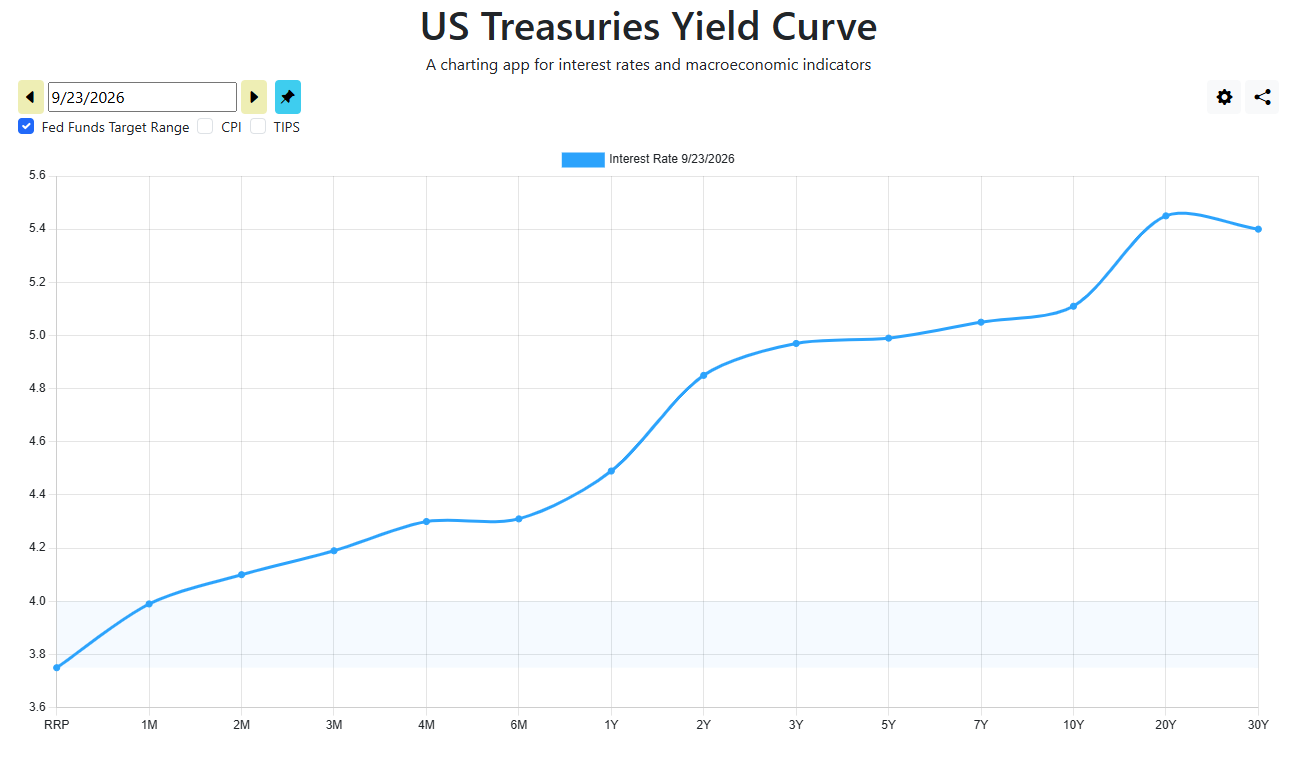
September 2026
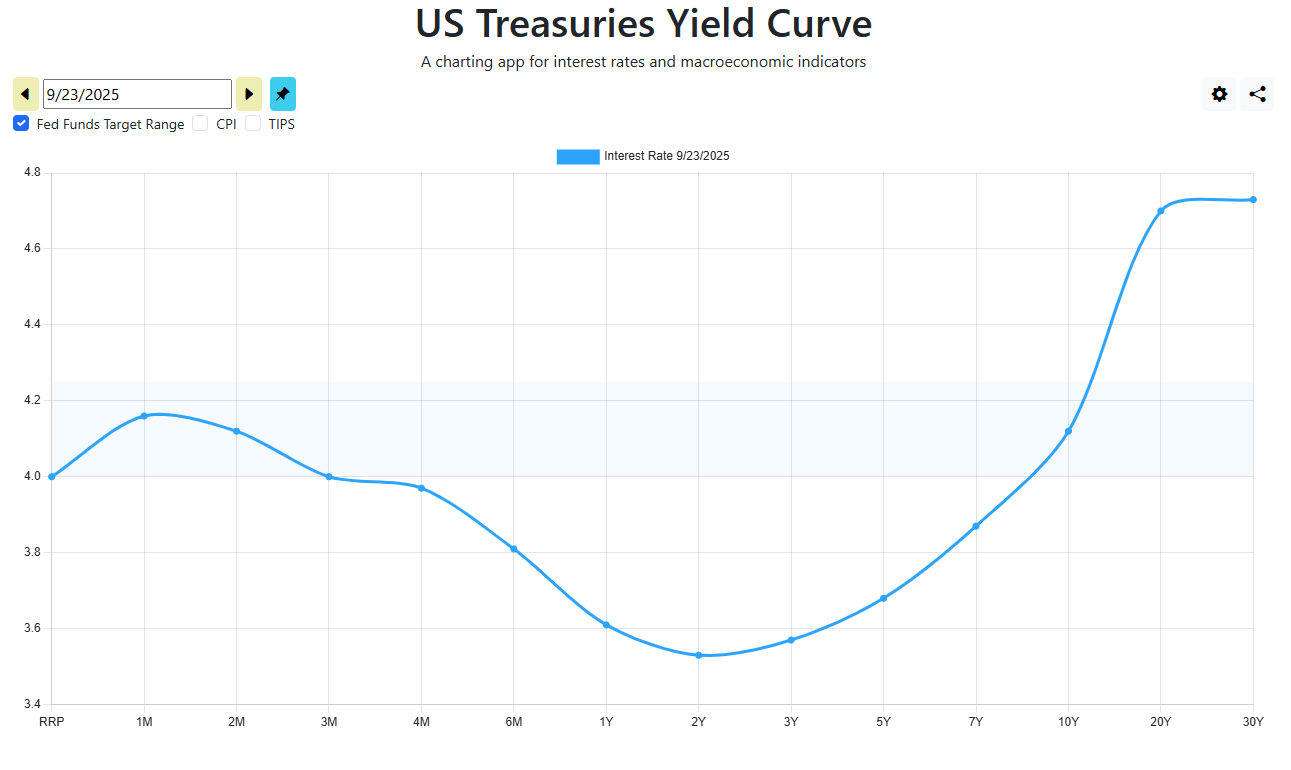
September 2025
Why not lock in for 30 years?
Well, if rates continue to rise and your “shock absorber” bucket of bonds is needed to support your life, we are going to have to sell those bonds. The further out they mature, the more sensitive they are to interest rate changes. If 30-year rates climb, the bond prices can move around like stock prices.
Remember in this case, bonds are our shock absorber; we need them to be there when we need them. We don’t need to inject additional risk here. This is our ballast. Let’s get compensated with a rate at a reasonable maturity. But the priority is not return on capital; it’s return of capital.
What about bond funds or ETFs?
For most of my clients, I prefer individual bonds. I can control the maturity profile, the issuers, etc. The portfolio isn’t impacted by other investors sending redemption requests or sell orders. Most recently, I wrote about the amount of AI-related bonds showing up in bond indexes. I can avoid that altogether by selecting bonds outside those industries.
What about high-yield bonds, private credit, floating-rate bonds, option call premium funds/etfs, name your higher yielding alternative here_____?
Nope, not for the shock absorber bucket. All these alternatives and "products” require extra scrutiny regardless, and simply do not meet the needs of the shock absorber bucket. I also advocate for simplicity. There could be reasonable and credible arguments for just about any investment. In my experience, it’s often not necessary, injects complication, and puts you no closer to a more enjoyable retirement. The opportunity for things to go awry is greater.
For some reason, investors are obsessed with “yield”. Something about receiving high interest payments makes investors foam at the mouth. And product-creating firms know this.
Yieldstreet, a 2015 startup with the promise of making investments outside of stocks and bonds available to everyday investors, generated losses across its suite of real estate funds. The idea of generating passive income was too attractive to some investors; now they are left with heavy losses. They’ve since rebranded…
Most recently, private credit funds have limited redemption requests as too many investors are heading for the exits. Regardless of the investment merits (I scrutinize them heavily btw), it serves little purpose if you can’t get your money out when you need to. So again, not for the shock absorber bucket.
So, What to do?
Simplicity rules here. If you are decades away from needing the money, this is largely noise. You need growth, and that’s what stocks are for. A “sell-off” in bonds only matters if you don’t know what the bonds are for.
If you are in or approaching retirement, you need a comprehensive strategy that considers your underlying withdrawal rate and the litany of qualitative and quantitative considerations. Simplicity is not easy, but it works.
And pretty please don’t chase yield.
If you would like me to inject some simplicity into your retirement strategy, schedule a 30-minute call here, and we’ll look at it together.