Let’em Build
I sat down a few weeks ago with San Antonio-based realtor and real estate developer Jaffar Chughtai to talk about the spring selling season in San Antonio. It’s a buyer’s market by any definition, with builders providing additional inventory on the edges of the city, offering rate buy-downs and warranties to entice buyers.
We also spoke about the challenges of dealing with residential investment real estate and why he has chosen to spend most of his time developing commercial real estate.
I have personally avoided investing in rental residential real estate as it wasn’t my cup of tea. I just find you’re a real estate guy or you’re not; and I’m not. While investment returns are one thing, returns on hassle are another. Plus, I can barely find a contractor to do work on my own home.
The conversation is up, watch or listen below.
Also, the conversation got me thinking about the bigger picture, the “K“ shaped economy, the housing affordability crisis, and how Austin, Texas, engineered an affordable housing boom.
I find it quite interesting how shaping public housing policy to support basic economic concepts like supply and demand can have profound results.
How Austin lowered housing prices: Economics 101: Supply and Demand
Last year, I wrote about demand-side housing solutions: The Federal Reserve can break the mortgage rate lock-in by crushing the spread between the current outstanding mortgage rate and the available new mortgage rate. And to my disappointment, we are yet to see any meaningful effort by the administration to move this needle. Perhaps they are waiting for Kevin Warsh to take the helm at the FED. We shall see.
In the meantime, Austin, Texas, has written the playbook on driving affordable housing, supply-side solutions. Let builders build and try to get out of the way. Well, it was more than just getting out of the way, the city committed hundreds of millions of dollars to support the effort.
Pew published a study in March on Austin’s affordable housing policies; Austin grew its housing supply by roughly 30% from 2015 to 2024, adding 120,000 units to its housing stock. This is more than three times the overall rate of growth in the United States at 9%. (1.)
The result? From 2021 to 2025, rents have decreased 4%, and inflation-adjusted rents have fallen 19%.
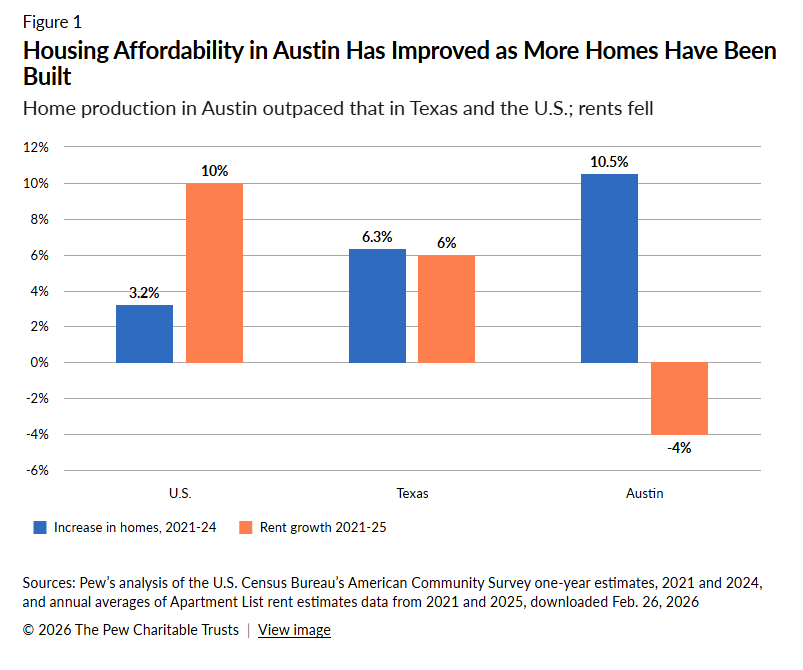
While half of the 120,000 units are in large apartment buildings, it feeds through the broader housing complex, leading to real affordability gains.
Key takeaway:
Real estate investing comes with risks public market investors rarely think about. A city council vote on zoning, parking minimums, or density bonuses can change the supply and demand dynamics of your local market in ways that take years to play out. Austin's renters benefited. Austin's landlords maybe not so much.